Bree Person: Removing the self and joining the collective
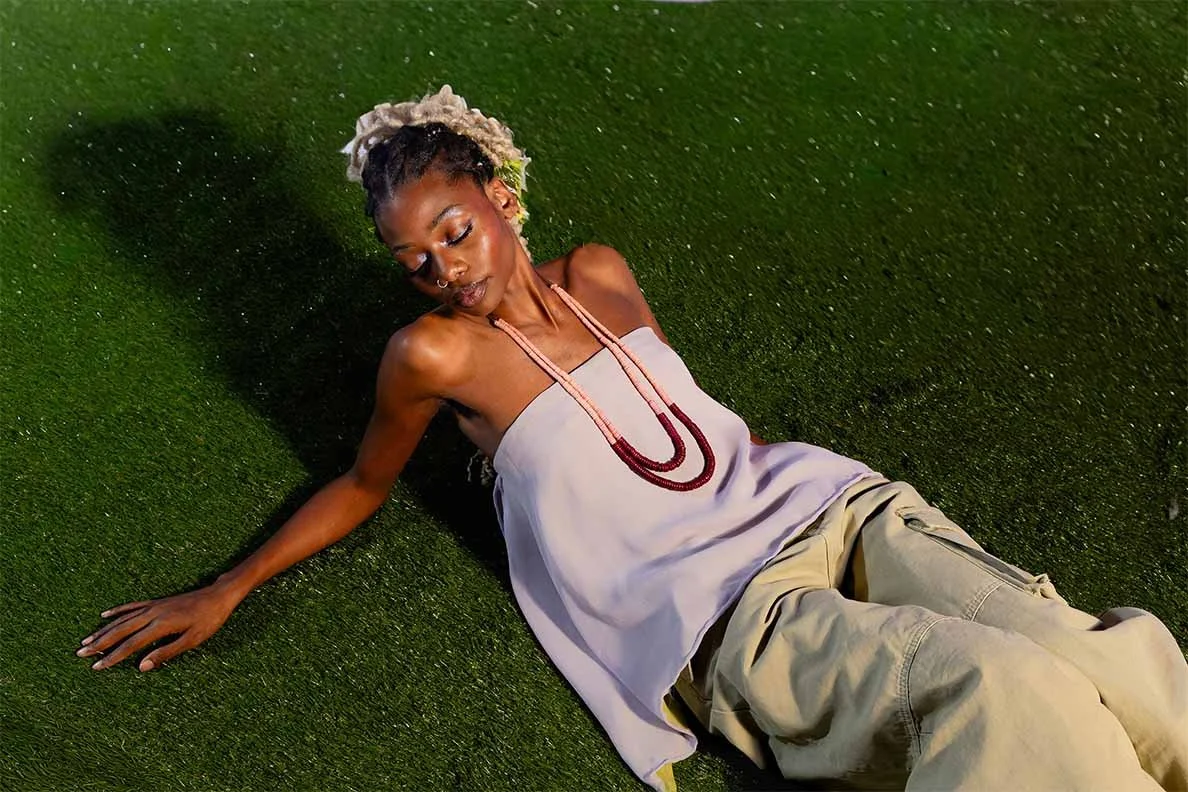
Creative Director Amani Kojo
Photographer Sebastian Bass
Lighting DJ Fralin
Stylist Jazzmine Williams
Makeup Artist Angela Star
Kojo: What is your name, or do you have a nickname?
Bree: My name is Bree. My name is so short, I do not have a nickname. It's straight Bree. A lot of people think it's Brianna or Brittany. I have a twin brother, too, but my mom was really simple with me.
Kojo: What's your twin brother's name?
Bree: Elijah. It's Bree and Elijah, the twins.
Kojo: Is your twin also an artist like you, or what's that like? I'm so interested in twins.
Bree: My twin brother is a professional dancer and he's also getting his master's in education. He goes on tours from time to time, but at the moment he's just focusing on getting his master's. We're very much from the Bronx, very much in the arts.
Kojo: Which part of the Bronx are you from?
Bree: I'm from the South Bronx.
Kojo: What kind of upbringing was that like?
Bree: In terms of my upbringing culturally or the environments I was raised in?
Kojo: Both.
Bree: I'm Black American. My grandparents are from North Carolina. Me and my brothers were the only ones raised in New York City. My father's family is also from New York City, but he doesn't have a lot of information on where his great-grandparents are from. I do a lot of research on my mother's side because I've spent a lot more time with them. Many of my summers and vacations were spent in North Carolina or Landover, Maryland. A lot of my family is in the DMV and in the South.
The environment I grew up in unfortunately had a lot of... activity. Lived in poverty, food deserts, things of that nature. The demographics were not predominantly Black Americans;
I was around a lot of different cultures that had negative stereotypes or stigmas around Black Americans. I found it difficult to find security or relation in my environments being from the South Bronx.
Having roots in North Carolina, I spent a lot more time around Black people in the South. Living in New York City, I've made a lot more Black friends in my 20s. In my teen years, I had a lot of Hispanic and African friends. I had a very strict upbringing. My parents knew how brainwashing television and mainstream media were. I wasn't allowed to watch TV during the weekdays. During the weekends, my dad was very active, so I swam. My brothers played basketball. We always rode bikes throughout parks. We were just very active children. Read a lot of books growing up; read a lot of books now.
My family is, you can say, somewhat conservative in a sense, in how they wanted to raise us. There was a lot of, I would say, conflict generally in families that I feel like a lot of us probably go through—you know, the little shadows that we deal with. My mom is a supervisor of the Manhattan VA Hospital. My father owns an electrical business in the Bronx and he also owns three buildings in the South Bronx. I grew up in an affluent home... but my environment did not reflect some of the things that I was taught or raised in. I found it kind of difficult to have relations with my peers because some people didn't come from the same resources that my family had.
I would say my upbringing was a little hard. I was the nerd. I was the weird kid. I didn't watch TV during the weekdays, so it was hard for me to relate to people if they weren't reading the same books as me.
My twin brother was a lot better socially because he "got light. " He danced a lot. He was popular. So I feel like I had somewhat of a balance. I also have a blood disorder called Sickle Cell Anemia. Some of my time would be spent in the hospital. Having that disability also reframed the way that I see the world and how I experience time and space with my body.
I went to school in New Jersey for a little bit—high school, Cliffside Park, Fort Lee area. A very affluent white neighborhood. I felt very out of place there. I feel like my life is just very interesting, just occupying different environments. My grandparents were very conservative Christians, so we weren't allowed to watch any TV that had cursing in it. It was mostly VH1, MTV, but if there were curses in the songs, they would immediately turn it off. So it was more like the Soul Train things that I was watching. I kind of grew up in a very timely Black home. Think Love Jones. Think Brown Sugar.
Kojo: Wow. It's truly interesting. I know that you mentioned to me on our phone call that you studied Anthropology, right?
Bree: Yes, I did study Anthropology in my undergrad. I went to three different colleges, though, so I did Art as an Associate's degree, and then I transferred to SUNY Purchase as an Anthropology major. And then I doubled in Media Studies. So I have three degrees.
Kojo: Why Anthropology? I mean, I know that you do set design and you also have a creative director hand, but what sparked that up for you? Was it something from your upbringing that catapulted that, or just an interest that you always had?
Bree: When I went to high school in Washington Irving, I was a part of a program called the Y Scholars Program, and I interned for WNYC Radio because that was also a sponsor of that program. I worked for WNYC Radio station for a year. And in that, I was able to produce my own story about having Sickle Cell Anemia, and it was aired nationally. I was able to meet all these different artists and journalists and I won a journalism award for my work. With that, I kind of fell in love with learning about the process of telling a story—the culture that's behind whatever that story is.
I've always been pulled to learning a little bit more about people that isn't just the surface. When I went to school at SUNY Purchase, I originally was trying to go for a Journalism major, but then I ended up going into Media Studies because that's the study of media. I kept having meetings with some of my professors because they were reading my papers and they were saying, "Oh, I see that you worked for a radio station. You put that in one of your papers. " And I said, "Yeah, I learned a lot from them. " She recommended that I major in Anthropology because it's the study of culture and she thought that I could benefit from the program.
I was like, why not? I majored in Anthropology and I kind of fell in love with it. It just gives such a breakdown on how to study culture in ways that... we carry subconscious biases towards other people and cultures. How to demystify that with how we integrate ourselves into that culture or how different people from different cultures integrate us into how they are navigating space. I just love the idea of learning a lot more about people—and learning about them through a discipline where it's not just you feeling like you know someone. You actually have to have a set of rules and conduct that you have to abide by while you're learning about this culture. I took Anthropology because I just wanted to feel like I had more of a sense of self in things that are going on around me. I love research. I love anything that's heavy in research. That's just kind of how my brain works.
Kojo: Do you feel like the degree that you studied in Anthropology... do you think that, because you mentioned a lot of getting a lot of different stimuli, did that somewhat help you make sense of those stimuli?
Bree: I feel like Anthropology has helped me have a lot more appreciation for different things that are happening around me, even if it doesn't incorporate or include me. I feel like a lot of times when we're learning about other cultures, I think a lot of people want to be centered in what other people have going on. Anthropology helped me to be okay with being the fly on the wall or being the one that's just the supporting person.
I think a lot of times when I am meeting other people, getting to know other people, or even learning about different cultures to a certain extent, I think subconsciously everyone has this thing where they want to be the center of attention, where they want to be the one that's like the all-knowing or sometimes even the most attractive or the most interesting person in the room.
Kojo: The ego.
Bree: Anthropology has helped me realize that,
if you center the ego in anything that you're doing, then you're essentially going to shoot yourself in the foot. You're not going to be able to really understand different phenomena happening around you.
There are so many things that are happening around me where I don't want to have a negative outlook on it just because I don't understand it, you know? Like, it's okay to see someone that has tattoos all over their face and not believe that they came from a traumatic household.
Anthropology, I feel, just helped me navigate my own ego in different spaces, and it's also helped me to have a lot more appreciation for why other people do things. It also helps me to dive into different things and be "bad" at it. I think some people dive into different interests or they want to be a part of different groups because they want to be the most important person in that group or they want to be the best at this thing. I like Anthropology because a lot of it is literally just being a part of something. It's not being the best at it. It's not being the most important person. It's about community. It's about learning. It's definitely helped me just feel like I'm a functioning human being in this world. That's what it helps me with.
Kojo: That reminds me... I recently read The Creative Act. You know Rick Rubin's The Creative Act?
Bree: Mm. No.
Kojo: It's a great book, but he mentions a lot about the collective consciousness that we have as artists and how the more we take away our ego from a project, the more a project can actually live and breathe in life. It's really dope that you mentioned that because it makes me just connect to something else. I'm interested in how you got into set design, right? Because I saw in one of your interviews that you said that you started your third year at Purchase. I'm guessing this is the latter end of your Anthropology degree. So how did that happen?
Bree: In one of my Anthro courses there was an anthropologist that was doing research on "bride wealth, " which is basically like in rural areas, a bride has funds through the family. If you come from a rural area, you get wealth when you marry because that woman has all this land and all these resources. The anthropologist that was studying this, she made this really cool art piece to talk about this phenomenon. I'm like, "This is a really interesting thing, to create a piece to kind of represent what you're studying. " And I was like, "I can make things to represent myself, or things that I'm going through or things that I'm feeling."
I was always making things generally. I love watching YouTube and I love watching DIY projects. And also, I told you
I have Sickle Cell; sometimes when I'm ill, I have to be in my room. I have to stay in my room. I didn't know how to talk about some of the things that I was going through with my health, so I just started making props and building sets in my room to kind of recreate how I wanted to feel about myself and how people saw me and my health.
I might be sick, but I don't believe the world that I live in is essentially just this sad person, you know? I would make clouds. I'd make sunlight. I'd just make my room into a garden. I can't go outside, so I make my own garden.
My body's not doing what I need it to do, so maybe I dress myself up like a fairy. I don't have to be sick. I'm a goddess, you know?
Studying Anthropology in undergrad and seeing that anthropologist make an art piece to represent what she was studying definitely inspired me to create my own pieces to help make sense of the world that I'm in.
Kojo: Yeah. I love that. I'm an actor, so sets and stuff... I feel like when people are watching a movie or a TV show, they always just look at the people talking, but so much goes into making a set. You're reimagining life in a way that people may not necessarily even realize. Everything goes back to Shakespeare, like "All the world's a stage. " Every little thing that's even in your room is just a set. I think that's really beautiful that, in defiance of your disability, you were making sets as if like,"Okay, I can go outside, well, I'm going to make the inside in." I'm making the outside inside. It's very inspiring.
Well, this is not even a question on the board, but I have a question about one of your sets where I saw bubble wrap in the train. I had so many questions about that because I interpreted it as: okay, this is a space where people are traveling a lot. It's kind of dirty for most of the time. People don't consider it to be fragile. I think something about bubble wrap makes me think, "Oh, this is a fragile thing. I don't want to pop it. And if I pop it, I know that I used some force to hold it. " So I don't know, was that connected to your identity as an artist, or were you trying to say something about the MTA?
Bree: So the piece is called Huth. H-U-T-H. And it's basically like a home without saying it's home. It's almost like missing home in a sense. It's almost like being homesick. For me, because I move a lot—different states, different boroughs, different homes—at least in my 20s, I'm trying to figure out what's the perfect space for me. I realized that I've had to have a different relationship with my objects than I usually do, where it's like, some items I'm never going to see again. Like when you move, you're going to lose something, you know? And I realized I had to detach myself from how I felt about the things that I would have in my home and just see it as like, "this is an experience.
" When it comes to me moving, the train has always been such a pivotal resource. It's always been there. I've lost so many things; the train has always been reliable. The train is one of those things where I feel like I'm never gonna lose this thing. It's a thing that we all use, and I feel like it's a safe space in a sense, where we know that this is always going to get us to and from where we need to go. If you lose something, it's like, "Okay, I might have lost that, but at least I know I can get home. " I feel like I've just been trying to reframe what's been an important resource in my life in ways that it's helped me mobilize myself in different stories.
I feel like bubble wrap is somewhat of a representation of the things that we try to take care of, the things that we try to put away. I also love haptic sensations, which is basically anything that you can touch, taste, or feel. I love anything that kind of makes you a lot more present in space, and bubble wrap is one of those things where I feel like everyone knows the sensation of popping bubble wrap. Everybody knows that bubble wrap is also a signifier of protecting your items. I wanted to use material that I know that we're all familiar with.
Kojo: Yeah, that's so true. I did some more research on some of your sets, and I had really admired how it always seemed to have a fusion between merging a garden with an urban space, like a tunnel or you're on top of a rooftop. It was a drone and you were laying on this plastic wrap mattress on the floor and then as he zoomed out, it was this kind of bedroom, but it was made up of basically construction wear. I also admired the mannequin with all of the floral things on it and you had put it in different spaces and touched it up with purple lighting. I thought all of that was really interesting because I feel like a lot of times when you're crossing around urban spaces and looking around, people don't necessarily take care of the space. But it's something about you putting that in the space that isn’t cared for. My brain goes,"Oh, we should low-key take care of the space because they got a beautiful thing in it. " I guess my question is: do you have an inspiration to make sets that connect to that urban lifestyle, or kind of shine a light on that?
Bree: The ways that I draw connection with my environments and my installations is derived from where I was raised and environments that I occupied growing up. Being from the South Bronx but having roots in North Carolina is somewhat like opposites. Being in North Carolina or even in Maryland, there are a lot more trees. There's a lot more space. There are a lot more parks. It's a lot more freeing. There's not as much public transportation. New York City is buildings and bricks and tunnels and trains. It's so different from North Carolina. Sometimes when I'm in the city, I have to look for these places to have "release. " I have to look for the park. Sometimes the park is in your area, but a lot of times when it comes to the projects, when it comes to city areas like Manhattan, I feel like it's hard to find greenery.
I feel like sometimes we forget that we are also a part of nature—regardless of if you're in the projects, if you're in a house, if you're living in the streets, we are human beings that are a part of nature.
I feel like being in the city, we forget that because we're hustling and trying to get to and from places in this grind culture. I feel like we don't know when to stop and take a break or slow down sometimes. Piggybacking off of what you said earlier, when I had my installation in certain spaces, it kind of gives that subconscious feel of, "I should take care of this. " You feel like, "I should be mindful of what I throw on the ground or even the people that are going to interact with whatever waste I leave here. " And I feel like this piece is also a representation for us to be a little bit more conscious of how we occupy space and that we are also a part of these spaces. This is also our nature. This is our environment.
I feel connected to both New York and North Carolina. I feel like it's just a deep connection not only in the spaces, but the migration of people. My granddad started off in North Carolina and then he migrated to New York City and then, basically, migrated back. It’s the fact that he knew that there was more for him somewhere else and that whatever space he was in was going to be accommodating to him. You have to believe in where you're at and you have to contribute to where you're at. I feel like that's nature. Nature is wherever you're at and we are contributing to it, whether we think about it or not.
Kojo: Who are some inspirations for you as a set designer?
Bree:
Absolutely. Oh, my God, Hannah Beachler. Hannah Beachler is one of my favorite set and scenic designers. She did Fruitvale Station. She did Creed, Creed II, Black Panther, Moonlight.
I watch her interviews. I absolutely love her work. She's a phenomenal set and scenic designer, and she's also a Black American woman who is one of the highest-paid scenic designers. She had the largest budget in the country! Black Panther had the largest budget for set and scenic design, and they trusted her with that. I love that woman. She's one of the first set scenic designers that I was studying. I love Karen Murphy. I think she's a London-based set scenic designer. She did some shows that I loved in the UK. Hannah Beachler, she's at the top. She's at the top for me. I'm going to add the installation artists. I love installation artists. I feel like they are just in their own realm of set design. Chiharu Shiota—she is Japanese-based. Herwork is so powerful. It touches on life, death, consciousness, awareness... her pieces take up so much space, but they tell such deep stories with just simple fixtures.
Kojo: What are the challenges that you face in the industry that you're in?
Bree: I think the thing that I have most difficulty with within this industry is how much money it costs to make anything, to build things. I've recently been able to work in production for different commercials and I've been in charge of seeing over some of the budgeting. It costs a lot. Even outside of professional production jobs, just as a freelance set designer, it costs a lot of money to build anything. It’s another fee for where that event is going to take place. It's not just building the set; sometimes it's about affording the place that it's in. There's so much money behind the decision-making to even produce anything. I think that's one of the hardest things.
I've had a lot of different artists reach out to me—models, producers—wanting to work with me. They underestimate how much money it actually takes for something to be executed well. I think that because of the way that I project my work on social media, some people believe that, "Oh, yeah, just hire her and she can get it done. " No. Your budget has to be way more than you even thought it was going to be. A lot of people don't really understand what goes behind a set designer's tasks, especially if you want something built in a space. I have to source workers. I need a source for someone to drive the van. I need people to carry the materials. Who's going to be manning the area while people are loading and unloading?
I also need to make sure that everyone's comfortable and people get along. I feel like sometimes with set design, I'm also managing relationships with other people. I have to make sure that whatever I'm doing, people feel fulfilled in whatever roles they're assigned. So it's a lot of push and pull socially as well. It's also making sure that the community that's a part of this feels represented and taken care of, you know. I also feel like people just generally might not do research around set and scenic designs. I've helped so many people get into the industry that I've seen people take advantage of my work ethic. So now it's all about navigating relationships, making sure you're taking jobs that you're going to be fulfilled in, and the budget has to be clear.
Kojo: What is something that you want your audience to know, whether to inspire them or for them to reflect on?
Bree: I would like everyone to know it's okay to do new things and not be the best at it, because I think life is genuinely about experiencing things and enjoying yourself. I do not like the ways that we create these very rigid ideas on how we should be as people. Like, "I'm a photographer. I want to be the best photographer. " And it's like,